# distributed_graph_flow
**Repository Path**: mirrors_google/distributed_graph_flow
## Basic Information
- **Project Name**: distributed_graph_flow
- **Description**: No description available
- **Primary Language**: Unknown
- **License**: Apache-2.0
- **Default Branch**: main
- **Homepage**: None
- **GVP Project**: No
## Statistics
- **Stars**: 0
- **Forks**: 0
- **Created**: 2025-09-03
- **Last Updated**: 2026-09-26
## Categories & Tags
**Categories**: Uncategorized
**Tags**: None
## README
# Distributed Graph Flow





**Graph Flow** (DGF) is an open-source Python library to train, evaluate, and
deploy Graph Neural Networks (**GNNs**) on tabular, relational, and temporal
data. It is developed by the Google GNN team, the team behind
[TensorFlow GNN](https://github.com/tensorflow/gnn), and is its successor.
Graph Flow has two APIs:
- The **Simple API** is as easy to use as scikit-learn: one function call
trains a GNN model from a graph and a target column, and the resulting
model can be evaluated, used for predictions, and saved.
- The **Advanced API** is a set of composable building blocks (graph IO,
samplers, feature normalizers, and JAX/Flax GNN layers). Like Lego bricks,
you pick the ones you need and assemble them with your own code, including
PyTorch Geometric models.
📖 **Documentation:** https://dgf.readthedocs.io/
This is not an officially supported Google product. This project is not
eligible for the [Google Open Source Software Vulnerability Rewards
Program](https://bughunters.google.com/open-source-security).
## 📦 Installation
To install DGF from [PyPI](https://pypi.org/project/dgf/), run:
```shell
pip install dgf -U
```
Graph Flow is available for Python 3.11–3.13 on Linux x86-64.
## 🔥 Why Graph Flow?
- **Simple API:** Train, evaluate, and save a GNN model in about 10 lines of
Python, without prior GNN experience.
- **Temporal graphs:** Dynamic graphs and time-series features are supported.
Time-aware sampling ensures that a model only sees information available
before the prediction time.
- **Scale:** Train in memory on graphs with up to 1B edges on a single
machine. For larger graphs, the distributed sampler (Apache Beam on Google
Cloud Dataflow) scales to trillions of edges.
- **Advanced API:** Message-passing layers (MPNN, GAT, Graph Transformer),
samplers, and normalizers are independent JAX/Flax building blocks for
custom models.
- **Interoperability:** Convert graphs to PyTorch Geometric, TensorFlow,
TF-GNN, and NetworkX.
- **Deployment:** Run inference in-process in Python, or export models to
TensorFlow SavedModel (e.g., for Vertex AI).
## 😎 Minimal usage example
```python
import dgf
# Download an example graph
graph, schema = dgf.io.fetch_ogb_graph("arxiv")
# Train a GNN model to predict the "labels" feature on the "nodes" nodeset
model = dgf.learning.train_node_model(
graph=graph,
schema=schema,
target_column="labels",
target_nodeset="nodes",
)
# Inspect training statistics, architecture, and schema
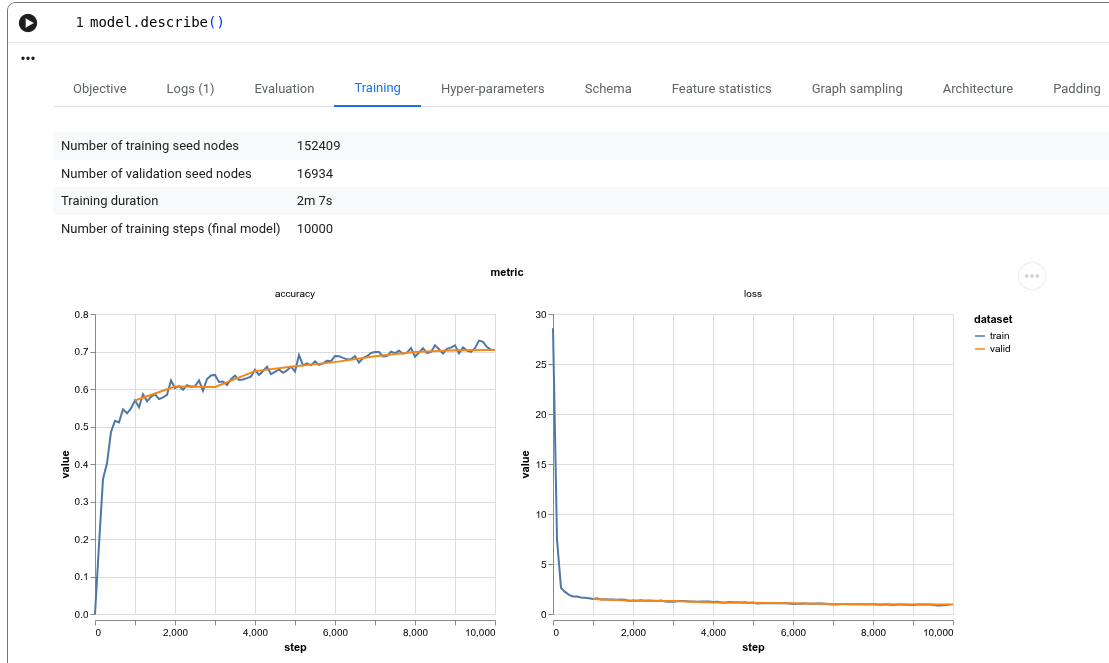
model.describe()
# Evaluate quality metrics
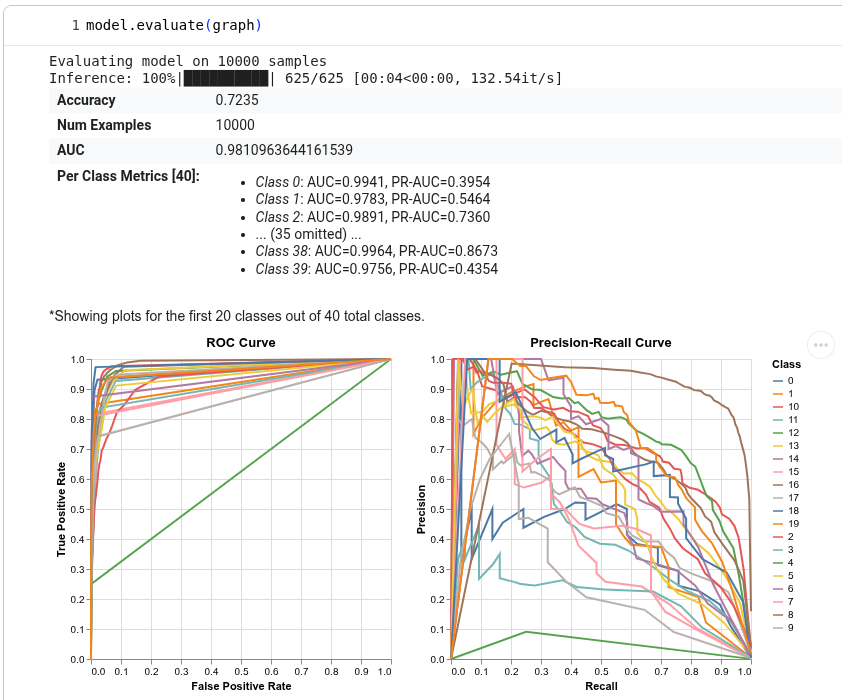
model.evaluate()
# Make low-latency predictions in-process
model.predict(graph, seed_node_idxs=[0, 1, 2])
# Save the model (architecture, weights, sampling config, training logs, etc.)
model.save("/tmp/model")
```
Output of model.describe()
Output of model.evaluate()
See the
[Getting Started tutorial](https://dgf.readthedocs.io/en/latest/tutorial/getting_started_simple_api.html)
for the complete walkthrough.
## 🤗 Need help?
- Read the [documentation](https://dgf.readthedocs.io/) and the
[Q&A](https://dgf.readthedocs.io/en/latest/qna.html).
- **Bugs & feature requests:** Open a
[GitHub issue](https://github.com/google/distributed_graph_flow/issues).
- **Contact the team:** Email us at
[distributed-graph-flow-contact@google.com](mailto:distributed-graph-flow-contact@google.com).